Posts

Showing posts from November, 2025

The Art of Inquiry: Why Specific, Neutral Questions Yield Better Data

In paranormal investigation, we often obsess over our answers. Did we get an EVP? Did the K2 meter light up? Did the psychic see a shadow? But we rarely analyze the Input: The Question. Whether you are interviewing a witness, conducting an EVP session, or using your own intuition, the quality of the data you receive is directly proportional to the quality of the question you ask. In data science, there is a rule: " Garbage In, Garbage Out. " If you ask a vague, biased, or loaded question, you will receive a vague, biased, or useless answer. To be a scientific investigator, you must become an engineer of questions. Here is why Specific and Neutral inquiry is the rigorous standard for paranormal research. 1. The Problem with "Leading" (Why Neutrality Matters) The human brain is an association machine. If you give it a hint, it will invent a connection. This is true for living witnesses, and it is true for your own intuition. The "Leading" Trap A leading...

What Kind of Science Is The Study Of Unidentified Flying Objects?

Image
  by Mark Cashman , Temporal Doorway Introduction One of the complaints frequently raised by those who are skeptical of the existence of Unidentified Flying Objects (UFOs) as an objective physical phenomenon is the nature of UFO data and the method by which UFOs are investigated. These complaints are based on a specific view of science and its data which is not necessarily appropriate to phenomena like UFOs. This is not to suggest, in any way, that UFOs are not amenable to scientific study. It simply means that the methods which work in one field of science are not necessarily appropriate to another. The interdisciplinary approach to studying UFOs as illustrated by Michael D. Swords in his paper “ A Guide to UFO Research ” (published in the Journal of Scientific Exploration) Science is an error-correcting method for developing knowledge. Unlike mysticism, which accepts intuition and revelation without comparison to real events or real objects, science rigorously requires su...

The Four Ways of Knowing, Rated: A Guide for Truth-Seekers

Image
  We make decisions every day — big ones, small ones, conscious and unconscious — and the quality of those decisions depends on how we know what’s true. Introduction: How Do We Know What’s True? In our search for truth, we rely on four ancient pathways of knowing — sensation, reason, authority, and intuition . Each of these pathways gives us access to a different aspect of reality, and each comes with its own strengths and blind spots. Each reveals something real, but each also hides something. No single way of knowing is complete on its own. Our senses show us the physical world, but they are limited and can be fooled. Reason helps us organize information and find explanations, but it can only go as far as our assumptions—and the depth of our own comprehension—allow it to go. Authority offers accumulated wisdom, but can also carry bias, manipulation, distortion, and dependency. Intuition gives us profound and sometimes transformative insight, but its signal is d...

The Investigator’s Toolkit: 7 Ways to Verify Intuition

Image
  Intuition: one of the 4 major ways of knowing   that may be related to nonlocal consciousness  Over the past two articles, we explored the inner landscape of intuition: 🔹 Intuition vs. Projection, Fear, and Fantasy (10 tests for separating genuine intuition from the most common internal distortions) 🔹  Intuition vs. Noise and How Your Mind Builds Meaning (22 tests that help separate genuine intuition from contextual, emotional, sensory, and cognitive impostors) Here, we move from understanding the impostors to practical techniques you can use in real investigations . These are hands-on methods for separating the Signal (true intuition/ESP) from the Noise (fear, imagination, bias, memory, bodily reactions, group influence). Below are 7 field-tested techniques you can use to verify whether a perception is intuitive, emotional, psychological, or environmental—so you can stay calibrated in any investigation. 1. The "Descriptors Only" Rule Target: Intellec...

Intuition vs. Noise and How Your Mind Builds Meaning (22 tests)

Image
  When we talk about “ intuition ,” it’s easy to imagine the mind receiving information cleanly — but in reality, every perception passes through layers we rarely notice. Beliefs, memories, bodily reactions, sensory cues, imagination, and logic all influence how an experience forms inside us. To tell real intuition or ESP from noise, we must first understand how these layers shape what we think we’re sensing. Image Source: Swann, I. (2018). Everybody’s guide to natural ESP. Swann-Ryder Productions, LLC. More info: Leimer, C. (2021). How the Man Who Taught Soldiers Remote Viewing Thought Intuition Works. https://christinaleimer.com/remote-viewing/ One way to picture this is as a processing ladder: your system loads old data, reacts through the body, interprets sensory input, fills in familiar patterns, and finally builds a story about what happened. By organizing " intuition impostors " according to this inner sequence, we can see where distortions begin — and how to p...

Popular posts from this blog

📌 What the Paranormal Is and What It Is Not

Ano ang Pinagkaiba ng Paranormal Philippines sa ibang paranormal group?

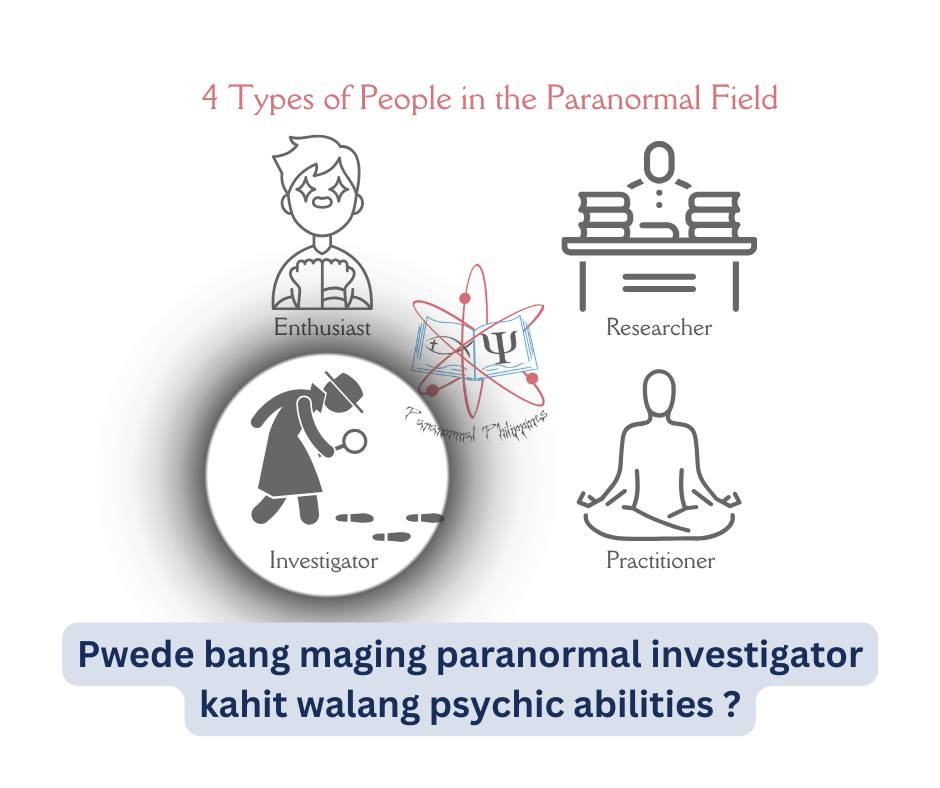
Pwede bang maging paranormal investigator kahit walang psychic abilities?